Giuseppe Uncini was born in Fabriano in 1929. After an initial self-taught artistic education, he moved to Rome in the early 1950s, coming into contact with the environment of abstract and informal experimentation. From the outset, he stood out for a rigorous and analytical approach, oriented towards the definition of a new relationship between form, space and matter.
In 1958 he began the Cementarmature cycle, works in which iron and cement become an autonomous plastic language: not imitation, but construction. In the following years he deepened his reflection on architectural space, developing the Spazicemento, Strutturespazio and Ombre cycles, in which sculpture confronts the idea of architecture as visual thought.
His research spans the decades with coherence and radicality, in dialogue with the evolution of European contemporary art. He died in Trevi in 2008, leaving a body of work that redefines the boundaries between sculpture, architecture and design.
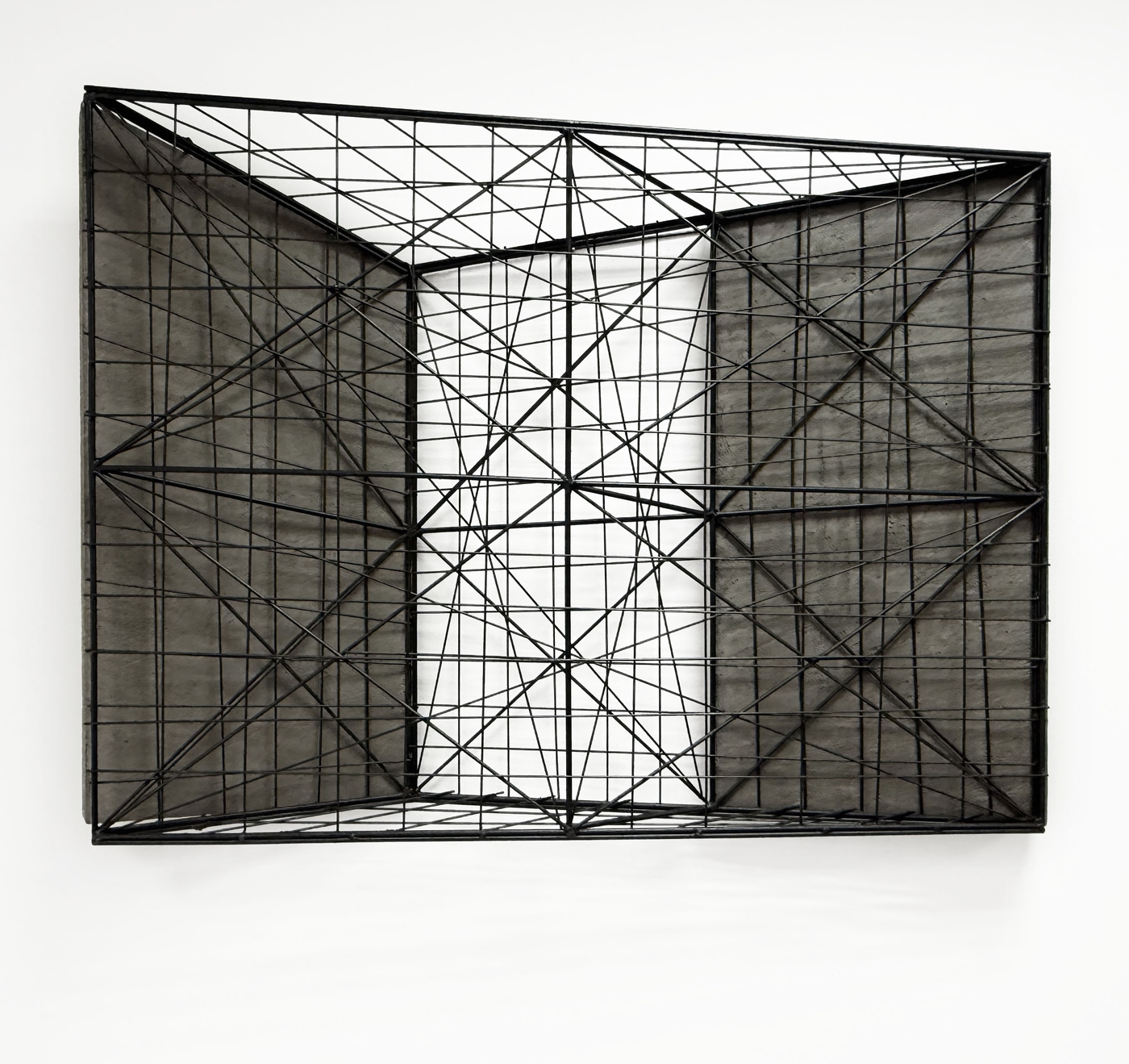
With Spazi di ferro, Giuseppe Uncini restores the dignity of thought to matter. Iron draws, cement supports: together they do not build, but reveal. The work does not represent space, it embodies it. It is an architecture stripped down to the bone, where the structure becomes form, and the form reflects the void that inhabits it.
There is no ornament, no narration: only the rigor of a language that has chosen nudity as a condition of truth. Uncini's geometries do not impose themselves, they resist. In them, weight becomes measure, the material becomes structural thought. Each work is a threshold, a tension held between presence and absence, between construction and ruin.
Spazi di ferro is the lucid attempt to inhabit silence with matter, to give a face to the invisible.
Giuseppe Uncini was born in Fabriano in 1929. After an initial self-taught artistic education, he moved to Rome in the early 1950s, coming into contact with the environment of abstract and informal experimentation. From the outset, he stood out for a rigorous and analytical approach, oriented towards the definition of a new relationship between form, space and matter.
In 1958 he began the Cementarmature cycle, works in which iron and cement become an autonomous plastic language: not imitation, but construction. In the following years he deepened his reflection on architectural space, developing the Spazicemento, Strutturespazio and Ombre cycles, in which sculpture confronts the idea of architecture as visual thought.
His research spans the decades with coherence and radicality, in dialogue with the evolution of European contemporary art. He died in Trevi in 2008, leaving a body of work that redefines the boundaries between sculpture, architecture and design.
With Spazi di ferro, Giuseppe Uncini restores the dignity of thought to matter. Iron draws, cement supports: together they do not build, but reveal. The work does not represent space, it embodies it. It is an architecture stripped down to the bone, where the structure becomes form, and the form reflects the void that inhabits it.
There is no ornament, no narration: only the rigor of a language that has chosen nudity as a condition of truth. Uncini's geometries do not impose themselves, they resist. In them, weight becomes measure, the material becomes structural thought. Each work is a threshold, a tension held between presence and absence, between construction and ruin.
Spazi di ferro is the lucid attempt to inhabit silence with matter, to give a face to the invisible.




Contatti
info@officinebit.ch