Ledger.swiss is the innovative institutional blockchain developed in Lugano.
OFFICINEBIT is involved in Ledger.swiss with ArtChain, a solution for digital certification of artworks, ensuring authenticity and transparency in the art sector. The collaboration with SwissLedger allows OFFICINEBIT to leverage blockchain to develop and test new applications related to digital notarization and certification.
Thanks to blockchain technology, ArtChain guarantees a reliable certification system that is immune to counterfeiting, offering the art market a new standard of security and transparency.

Each artwork is associated with a unique identifier (cryptographic hash) generated from its essential data, such as:
These data are recorded on the blockchain permanently, creating a kind of “digital passport ”of the work.
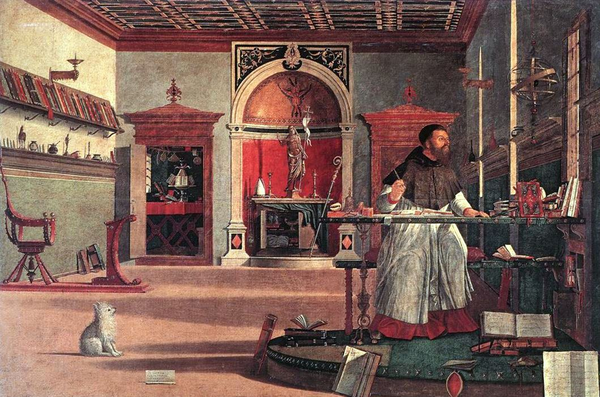
Vittore Carpaccio. Saint Augustine in his study, c. 1480.
Tools of writing and knowledge are arranged as traces of a code under construction, elements of a language that articulates between presence and registration. The mystical vision becomes a metaphor for an algorithmic epiphany, a passage of state in which matter dematerializes into information, transforming thought into a structure of verifiable data.
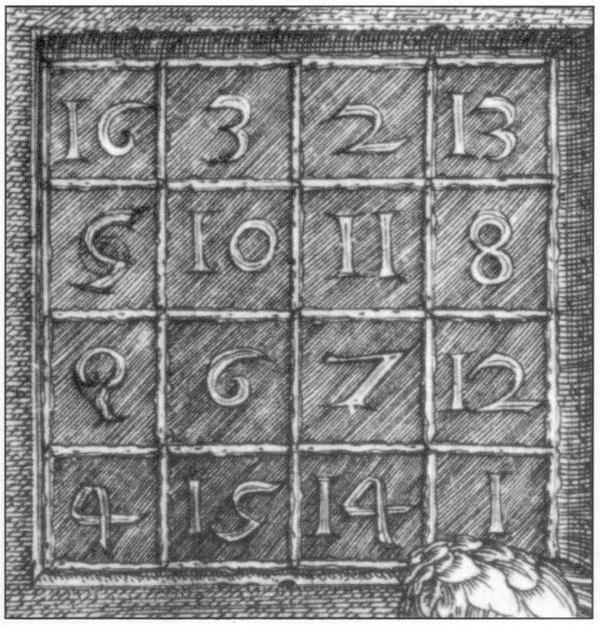
Albrecht Dürer. Melencolia I, 1514 (Detail of the magic square)
Dürer's engraving is configured as a device of knowledge, a visual organism in which every element-from measuring instruments to polyhedra, from the magic square to alchemical symbols-is encoded in a system of relationships. It is an archive in power, a network of signs that records and structures information, anticipating computational logic.
The magic square becomes a metaphor for an original cryptography, a visual algorithm in which each number is a node validated by its position and relationship to the whole. Like a cryptographic hash, it seals memory in a precise order, ensuring its integrity and permanence over time. “Melencolia I” is thus a decentralized proto-record, a distributed intelligence that organizes knowledge in an encrypted and verifiable language, prefiguring the ‘digital passport’ of the artwork in the blockchain.
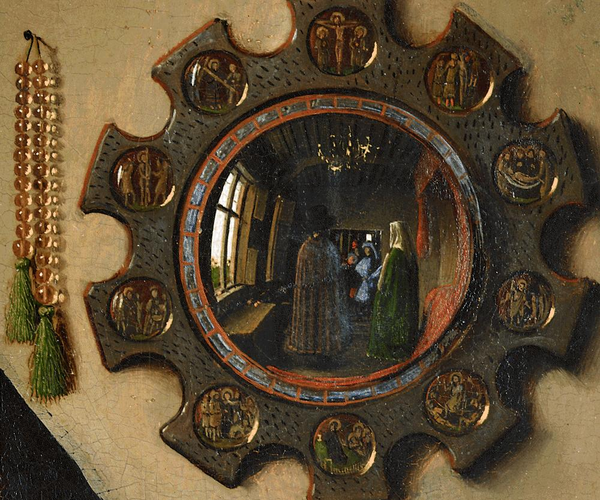
Jan van Eyck. Portrait of Mr. and Mrs. Arnolfini, 1434 (detail of mirror)
In Jan van Eyck's “Portrait of Arnolfini,” art becomes a “visual document” certifying the marriage, a proof of authenticity through light, details and the play of mirrors. The painting is a “seal” that testifies to the event, fixing it in a visible and immutable act.
Like the blockchain, which guarantees the origin of works, the painting acts as a “digital certificate” that binds image and reality. The reflection in the mirror, showing the painter and a possible witness, suggests transparency and truth, concepts central to the certification of authenticity.
In some cases, the work can be tokenized (NFT or fractional ownership tokens), enabling eventual digital asset management.
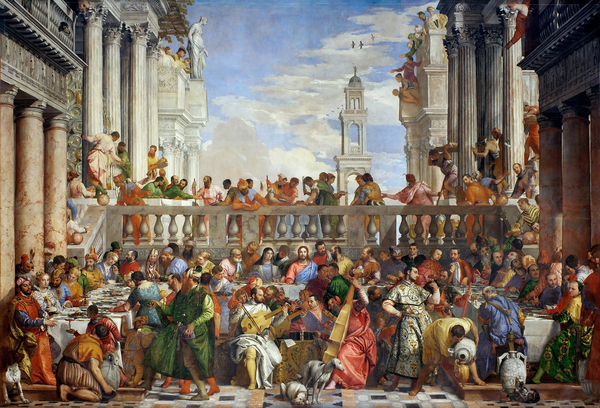
Paolo Veronese. The Marriage at Cana, 1563
With its richness of detail and multiplicity of figures, the work becomes an image that breaks down into parts that, while independent, constitute a whole. This fragmentation evokes the concept of tokenization: the work, divided into digital tokens, allows multiple owners to participate, each with a fraction of the whole. Each part, while separate, retains its connection to the original work, like the characters in the banquet, united in the whole.
Tokenization thus democratizes art, distributes value and makes it collectively usable and accessible.




 Scarica il PDF
Contatti
info@officinebit.ch