Value 65'000 EUR
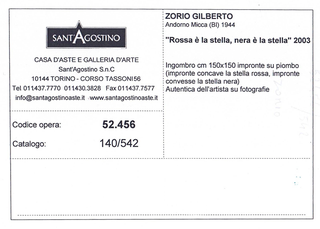
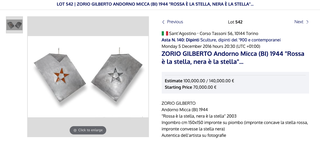
In December 2016, the work was offered for auction with an estimate of between €100,000 and €140,000, and a starting price of €70,000. ArsValue.com
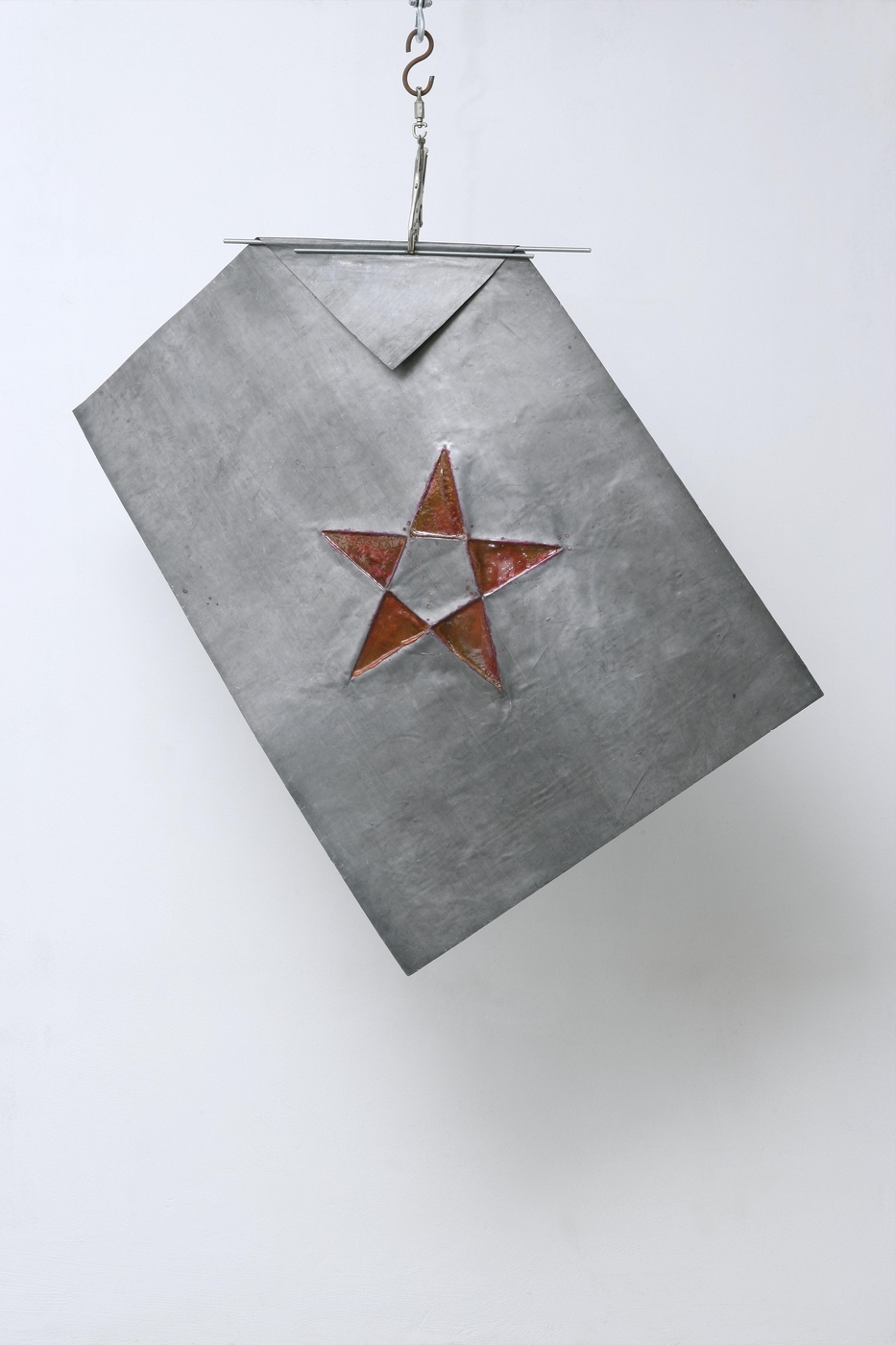
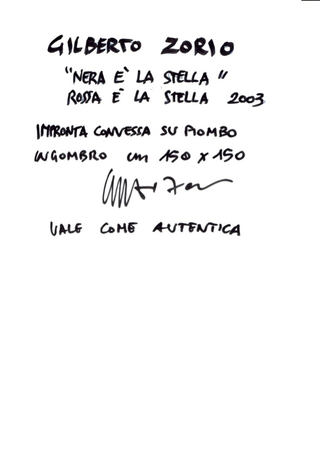
The work Rossa è la stella / Nera è la stella (2003) is a sculpture with a strong symbolic and material charge, which is part of the artist’s long and coherent investigation into the concepts of energy, transformation and tension between opposites.
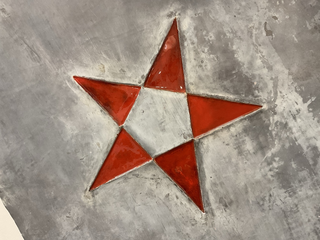
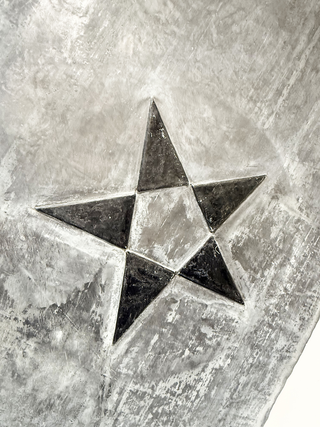
Made of lead and paint, with a double concave imprint that alludes to the two stars in the title — one red and one black — the work takes on a meditative and at the same time dynamic form. Lead, a dense, toxic material associated with gravity and transmutation, is often used by Zorio as a support for an invisible tension, as if it were the point of impact of opposing forces. Here, the sculpture develops along a flat surface but with sculpted imprints, almost to suggest an imprinted memory, a fossil echo of cosmic, political or emotional events.
The stars, central symbols in Zorio’s practice, are at the same time orientation tools and ideological icons. The red star and the black star face each other or perhaps complement each other, in an unstable balance between light and darkness, revolution and denial, affirmation and disappearance. One is the matrix of the other, and vice versa.
The choice of the double title accentuates the dual nature of the work, which can be read as a counterpoint between presence and absence, between symbol and matter. It is not a diptych, but a sculpture that contains within itself two poles of meaning.
Zorio does not build objects, but fields of plastic energy, places in which matter is activated by conceptual and physical tensions. Red is the star / Black is the star is one of these “batteries”, capable of storing and releasing meaning, without ever exhausting it
Gilberto Zorio (Andorno Micca, 1944) is an alchemist of form, a tireless experimenter who has made energy the fulcrum of his artistic practice. Since the 1960s, in the context of Arte Povera, Zorio has operated in the domain of transformation, orchestrating tensions and material mutations that challenge the inertia of traditional sculpture.
His research is nourished by processes in progress: the oxidation of metals, the evaporation of liquids, the tension between contrasting forces. Archetypal elements such as the star, the javelin and the canoe become condensers of energy, forms charged with meaning and dynamic potential. Matter is never static, but crossed by chemical and physical flows that redefine it in space and time. The work becomes a field of forces, an unstable machine that intercepts movement and change, exalting the friction between nature and artifice, between past and future.
Having exhibited in major international museums – from the Centre Pompidou in Paris to the MoMA in New York, from the Stedelijk in Amsterdam to the Venice Biennale – Zorio has built a plastic lexicon that dissolves every boundary between sculpture, installation and performance. His works are living organisms, open systems that interact with space and the spectator, in a continuous oscillation between balance and precariousness, light and shadow, explosion and waiting.
Value 65'000 EUR
In December 2016, the work was offered for auction with an estimate of between €100,000 and €140,000, and a starting price of €70,000. ArsValue.com
The work Rossa è la stella / Nera è la stella (2003) is a sculpture with a strong symbolic and material charge, which is part of the artist’s long and coherent investigation into the concepts of energy, transformation and tension between opposites.
Made of lead and paint, with a double concave imprint that alludes to the two stars in the title — one red and one black — the work takes on a meditative and at the same time dynamic form. Lead, a dense, toxic material associated with gravity and transmutation, is often used by Zorio as a support for an invisible tension, as if it were the point of impact of opposing forces. Here, the sculpture develops along a flat surface but with sculpted imprints, almost to suggest an imprinted memory, a fossil echo of cosmic, political or emotional events.
The stars, central symbols in Zorio’s practice, are at the same time orientation tools and ideological icons. The red star and the black star face each other or perhaps complement each other, in an unstable balance between light and darkness, revolution and denial, affirmation and disappearance. One is the matrix of the other, and vice versa.
The choice of the double title accentuates the dual nature of the work, which can be read as a counterpoint between presence and absence, between symbol and matter. It is not a diptych, but a sculpture that contains within itself two poles of meaning.
Zorio does not build objects, but fields of plastic energy, places in which matter is activated by conceptual and physical tensions. Red is the star / Black is the star is one of these “batteries”, capable of storing and releasing meaning, without ever exhausting it
Gilberto Zorio (Andorno Micca, 1944) is an alchemist of form, a tireless experimenter who has made energy the fulcrum of his artistic practice. Since the 1960s, in the context of Arte Povera, Zorio has operated in the domain of transformation, orchestrating tensions and material mutations that challenge the inertia of traditional sculpture.
His research is nourished by processes in progress: the oxidation of metals, the evaporation of liquids, the tension between contrasting forces. Archetypal elements such as the star, the javelin and the canoe become condensers of energy, forms charged with meaning and dynamic potential. Matter is never static, but crossed by chemical and physical flows that redefine it in space and time. The work becomes a field of forces, an unstable machine that intercepts movement and change, exalting the friction between nature and artifice, between past and future.
Having exhibited in major international museums – from the Centre Pompidou in Paris to the MoMA in New York, from the Stedelijk in Amsterdam to the Venice Biennale – Zorio has built a plastic lexicon that dissolves every boundary between sculpture, installation and performance. His works are living organisms, open systems that interact with space and the spectator, in a continuous oscillation between balance and precariousness, light and shadow, explosion and waiting.




Contatti
info@officinebit.ch